
Class 7 English Worksheet: Argument Essay Structure

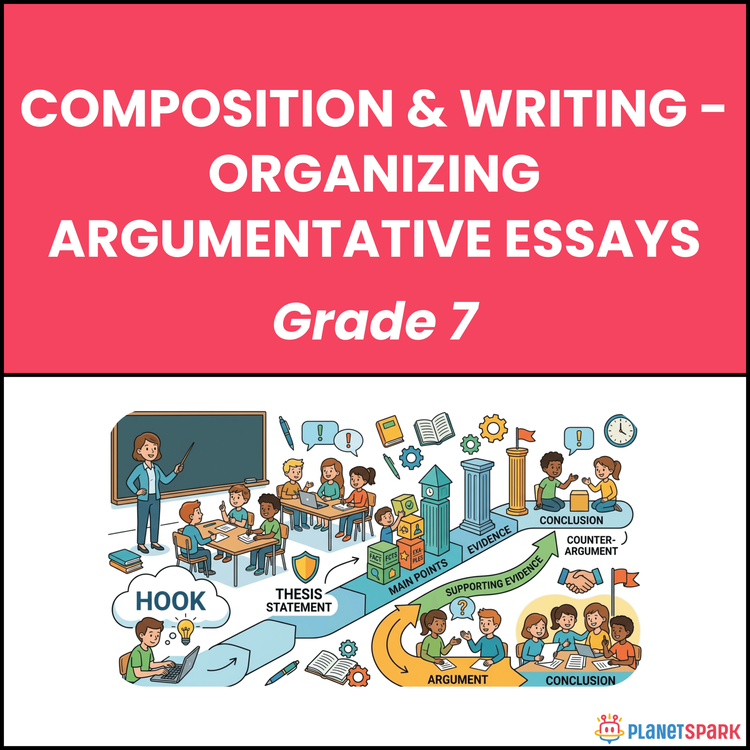
Class 7 English Worksheet: Argument Essay Structure
Unlocking Arguments: Essay Structure Worksheet for Class 7
This Grade 7 worksheet focuses on organizing argumentative essays using a creative story-based approach. Students explore the structure of a strong argument through an engaging narrative, “The Vault of Five Reasons,” where each part of an essay—claim, evidence, reasoning, counterclaim, rebuttal, and conclusion—is represented symbolically.
Through a variety of exercises including multiple-choice questions, fill in the blanks, true/false, error identification, and paragraph completion, learners strengthen their understanding of how to build logical and persuasive arguments. The worksheet develops critical thinking, reading comprehension, and grammar skills in a meaningful and age-appropriate way.
Why Argument Essay Structure Matters in Grammar?
Argumentative writing helps students organize thoughts clearly and present ideas logically. For Grade 7 learners, this topic is important because:
1. It teaches how to present and defend opinions effectively.
2. It builds logical reasoning and critical thinking skills.
3. It improves structured writing for academic success.
4. It encourages evaluating different perspectives before concluding.
What’s Inside This Worksheet?
This worksheet includes five grammar-rich activities that build strong argumentative writing skills:
Exercise 1 – Multiple Choice Questions
Students answer comprehension and reasoning-based questions from the story.
Example: Identify the role of “Money helps people too” in the argument.
Exercise 2 – Fill in the Blanks
Students choose appropriate academic vocabulary words such as “arguable,” “evidence,” and “refutation” to complete sentences.
Exercise 3 – True or False
Students evaluate statements based on their understanding of the story and argument structure.
Exercise 4 – Underline the Incorrect Word
Students identify words that do not match the meaning or logic of the sentence, improving conceptual clarity.
Exercise 5 – Paragraph Completion
Students complete a structured paragraph using key argument terms to reinforce learning in context.
Answer Key (For Parents & Educators)
Exercise 1 – Multiple Choice
1. d) To prove ideas must be organized logically
2. c) It avoids evidence
3. a) A counterclaim
4. b) It supports the need to protect the maps
5. c) Connection
6. d) Wealth disappears, while water saves generations.
7. a) He values quick profit over long-term public need.
8. b) It connects the moral decision to the final action
9. a) A logical argument reaching completion
10. c) Structured thinking can protect justice
Exercise 2 – Fill in the Blanks
1. arguable
2. validates
3. inference
4. opposition
5. refutation
6. priority
7. stepwell
8. ethical
9. civic
10. sequence
Exercise 3 – True / False
1. True
2. False
3. True
4. False
5. True
6. True
7. True
8. False
9. False
10. True
Exercise 4 – Incorrect Words
1. hidden- stated
2. imaginary- reliable
3. repeats- interprets
4. weaker- fairer
5. avoid- address
6. generosity- greed
7. decorate- guide
8. private- public
9. random- ordered
10. shout- reason
Exercise 5 – Paragraph Completion
claim, evidence, reasoning, counterclaim, rebuttal, logic, conclusion, responsibility, structure, community
Help your child master structured argumentative writing and critical thinking skills with engaging story-based practice designed for real academic success.
Frequently Asked Questions
An argument essay usually includes an introduction with a clear claim, body paragraphs with reasons and evidence, and a conclusion that restates the main idea.
The introduction should present the topic, give some background, and clearly state the main claim or opinion.
Students can improve by planning their ideas, using clear paragraphs, and ensuring each part connects logically to the main claim.